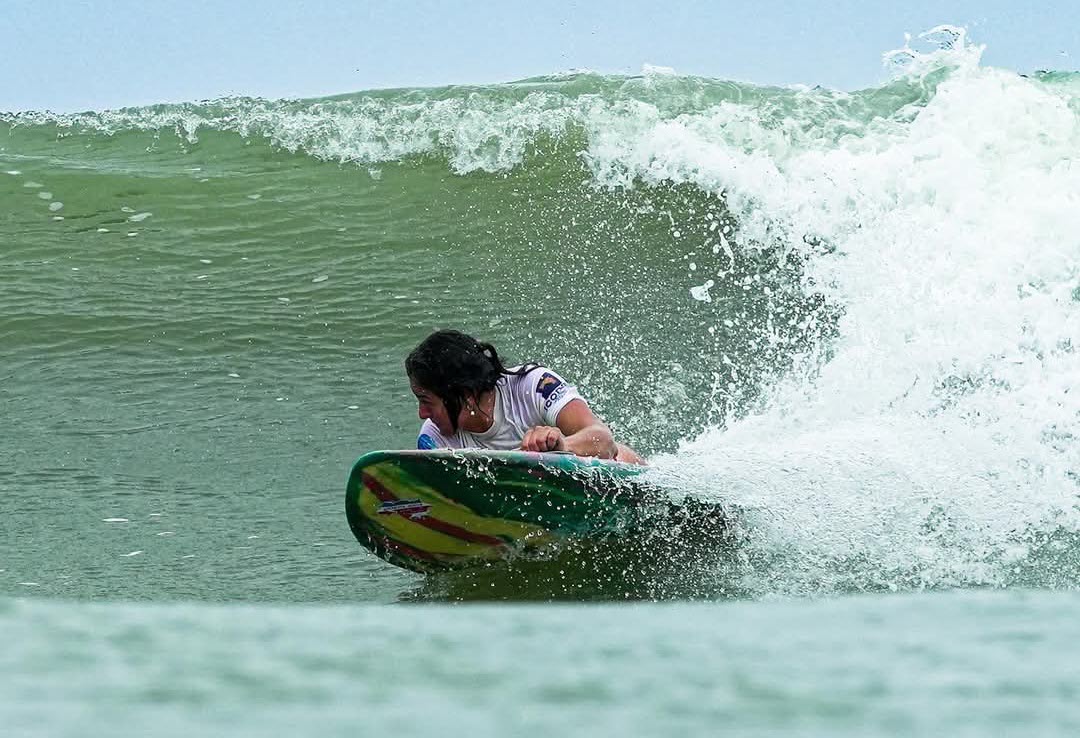
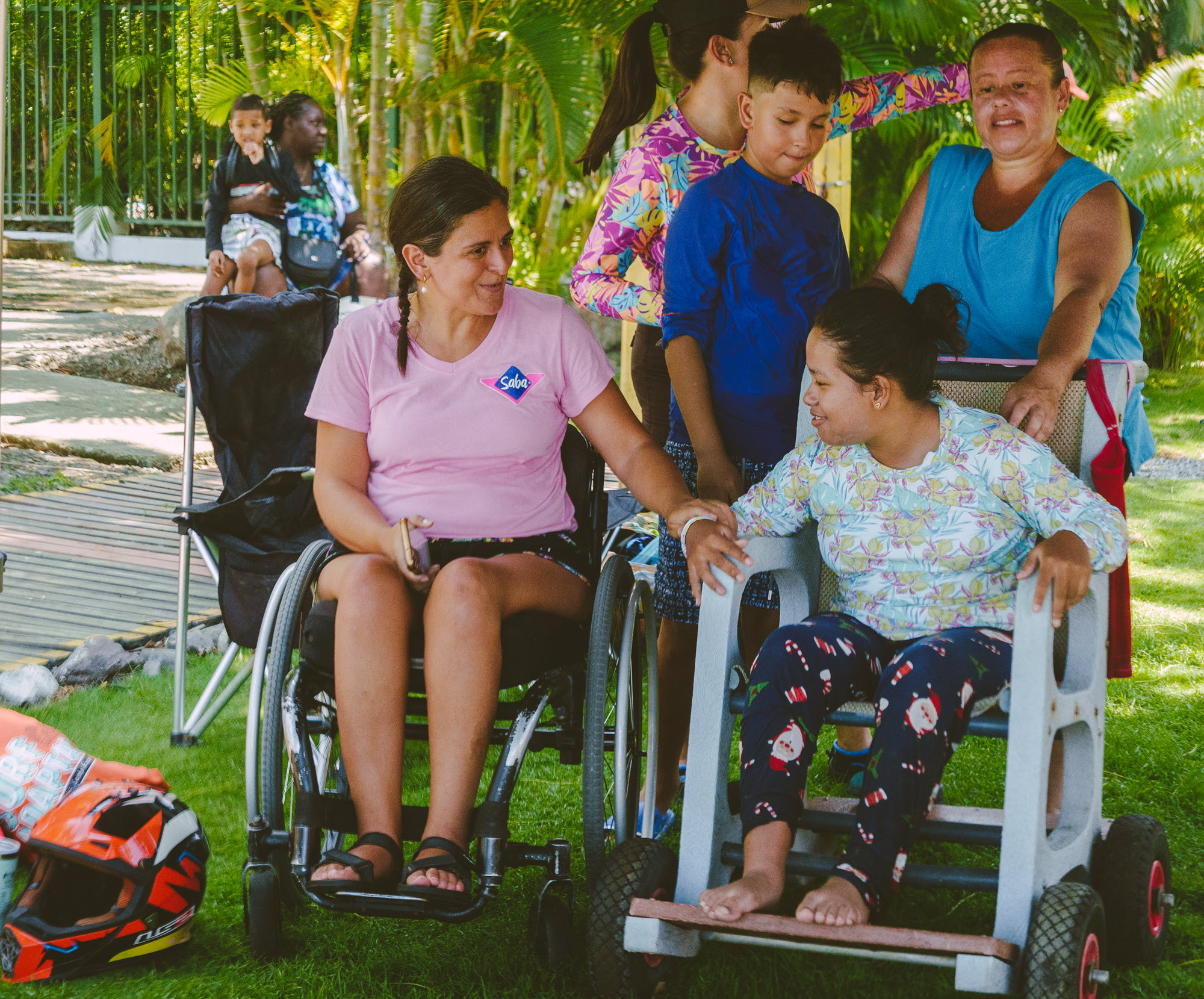
Spend a few moments talking with Natalia Vindas, and you’ll understand clearly that there’s not much this woman can’t do. She’s a champion parasurfer; the co-founder of the Adapted Surf Association of Costa Rica, and now its president; a civil engineer who helps create accessible spaces; and an inspiring speaker, she spends her time advocating for inclusion and access.
At the same time, she’s very open about a reality that many nonprofit leaders experience every day: a lack of training and support for the tasks they have to carry out to develop and sustain their organizations.
“We’ve done shirt sales, raffles… everything but putting ourselves in an auction — all without really knowing how to fundraise.”
For the Adapted Surf Association, an Amigos affiliate that promotes access to the sport for people with disabilities, training on fundraising has been a need throughout its existence.
“We need support in this kind of organization where we work with lots of love, but con las uñas—we’re hanging on by our fingernails!”
“We don’t have experience, you know?” she says of tasks like fundraising and management. “Every year since [the initiative] started in 2015, there’s been fundraising. We’ve done shirt sales, raffles, everything but putting ourselves in an auction… but it’s all been without really knowing how to fundraise. It has all been experimental.”
Developing a Fundraising Mindset
That’s why, according to Natalia, the support provided by Amigos of Costa Rica—and, in particular, its new Fundraising 101 training that she participated in last September as part of Amigos’s new Training Plan—have been an essential aid.

Amigos of Costa Rica Affiliate Coordinator Adriana Alfaro explains that the training has been designed in direct response to what affiliates requested in the in-depth self-assessment that Amigos coordinated for its approximately 125 affiliates earlier this year (read more in September’s blog post). The survey included questions about the kinds of trainings that affiliates wanted to receive most urgently, and fundraising was the clear front-runner.
“They want to learn how to make an ask… how to find donors… how to do prospecting.”
However, parsing the affiliates’ responses, she says that she and Executive Director Emily Arnold could see that it was important to start at the beginning: with organizations’ fundraising mindset.
“Nonprofits end up having to do 25 things in a single day and try to stay afloat, so you stay very transactional,” she says. “What is the most important thing? Long term relationships, having a donor cycle or process—not just ‘give me money, thanks, goodbye’... Everybody wants major donors, but if you don’t have your basic documents and a prospect list, there's no way you can get that. And if you don’t have the proper fundraising mindset, you don’t know how to prospect donors or make an ask.”
With that in mind, Amigos designed the first rung on its training ladder: Fundraising Mindset. The 90-minute session helps affiliates learn not just the practical steps to start designing a calmer, more organized approach to fundraising, but also some cultural shifts that Adriana, a nonprofit veteran and former Amigos affiliate leader, has learned are key.
“We need to be comfortable and excited about what we do instead of feeling uncomfortable about asking for money.”

“I have three massive books that I used for technical information for this training, but I had to translate all of it—not in the sense of language, but in the sense of culture. In the sense of how we as Costa Ricans need to be proud of the work that we do,” she says. “We need to be comfortable and excited about what we do instead of feeling uncomfortable about asking for money…. There's a lot of that that showed up in the needs assessment, that people really feel insecure. It gives us so much to work on and to assist them with.”
Immediate Impact—and Long-Term Growth
A total of 18 people representing 12 Amigos affiliates participated in the first implementation of the training in September. Natalia was one of them. Speaking just weeks after the experience, she said that Adapted Surf is already applying what was learned.
“It gave us so much clarity about the process of finding donors who are aligned with our cause, and not just try things randomly,” she says. “It has helped us organize certain documents that make the donation process more agile.”
Beyond just fundraising knowhow, she says the training and the overall support from Amigos and from Adriana have helped provide stability during the often unsteady experience of running a nonprofit.
“This organization is like a child, and you don’t abandon a child… The support of Amigos has been very important to keep us from throwing in the towel.”
Asked what she’d say to affiliates who haven’t yet taken part in the training, Nati says the choice is clear.
“It’s a free resource… the time you put into it, you get back in time you save in other things.”
What’s Next for Amigos Training
For next year, Adriana and Amigos are developing the next trainings in the pipeline. Adriana says that Fundraising Mindset will likely become the intro course where all new affiliates begin, offered every quarter as part of affiliate onboarding.
However, additional courses will be offered in a learning management system that allows people to pick the trainings they need at any time.
“We wanted to do the basics this year so that next year, we can go deeper: into major donors, into more intermediate kinds of fundraising,” she says. “We’re trying to open all the options.”
And Amigos will be tracking the results of this initial training and all those that follow.
“We're not just giving training so that we can say we're trained people,” she says. “We're going to track it. We're going to see improvement. We're going to complement it with coaching, with direct one on one feedback, with site visits.” In addition to all of this, Amigos is also paying for outside experts to facilitate additional learning opportunities, and recently gave scholarships to five affiliates to attend the International Sustainable Tourism Conference: Planet, People, Peace in San José.
All of this is truly strategic to what we believe is the most important thing, which is to help these organizations have more impact, raise more funds, and be there for their communities and for the country.”
When it comes to a leader like Natalia, “it’s not just one person being trained,” says Adriana. “If I support Nati in finding more donors, that means more people with a disability all over the coast can learn from a national champion. We’re just helping Nati find the strength and the systems that will help her grow as an organization.”